- Date 2026-08-28
- Hit 8
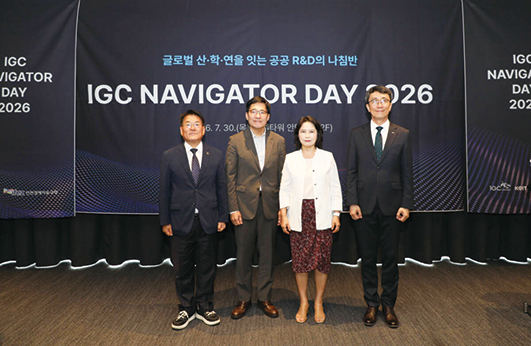
IGC Foundation Hosts Navigator Day 2026 to Strengthen International Joint R&D Cooperation
The Incheon Global Campus (IGC) Foundation recently held IGC Navigator Day 2026 to strengthen researchers’ ability to plan public R&D projects and expand cooperation with government R&D agencies.
The event was held as part of the IGC International Joint R&D Planning Research Program. Approximately 70 participants attended, including officials from the Ministry of Trade, Industry and Energy; the Incheon Free Economic Zone Authority; the Korea Evaluation Institute of Industrial Technology (KEIT); and the Korea Institute of S&T Evaluation and Planning (KISTEP), as well as researchers from universities and research institutions based at IGC.
Participants shared approaches to research planning aligned with government R&D programs and explored ways to expand the foundation for international joint research.
The IGC Foundation supports the entire process of connecting the research capabilities of overseas universities and research institutions with government-funded R&D, from project planning and task identification to matching with specialized agencies and building networks.
It plans to continue identifying international joint research projects in future strategic industries, including smart manufacturing, semiconductors, and biotechnology, while expanding participation in government R&D programs and strengthening cooperation among industry, academia, and research institutions.
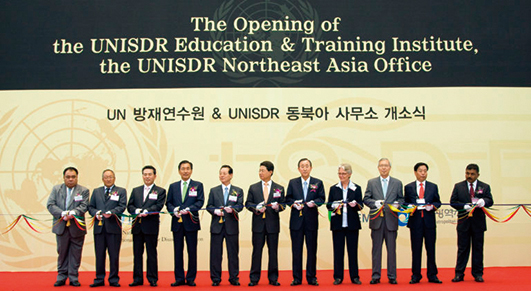
Government Support for UNDRR ONEA and GETI Extended Through 2031
Government administrative and financial support for the United Nations Office for Disaster Risk Reduction (UNDRR) Office for Northeast Asia (ONEA) and the Global Education and Training Institute (GETI) in Songdo has been extended through 2031.
The Ministry of the Interior and Safety recently signed an agreement with UNDRR to extend the current support arrangement. Under the extension, the government plans to continue strengthening international cooperation to address the climate crisis and complex disasters.
The measure aims to maintain Korea’s role as a hub for disaster risk reduction cooperation in Northeast Asia and to expand collaboration with the international community.
UNDRR is a UN body responsible for developing international disaster risk reduction strategies and coordinating cooperation among related organizations.
Established in Songdo in 2010, ONEA implements disaster risk reduction cooperation projects among five Northeast Asian countries: Korea, China, Japan, Mongolia, and North Korea. GETI supports global disaster response capacity by identifying and supporting experts and by sharing specialized knowledge and innovative technologies.
Under the extended agreement, Songdo will continue to serve as a hub for disaster risk reduction cooperation and for international education and training in Northeast Asia.
GGGI Expands Green Growth Cooperation with Cambodia and Laos
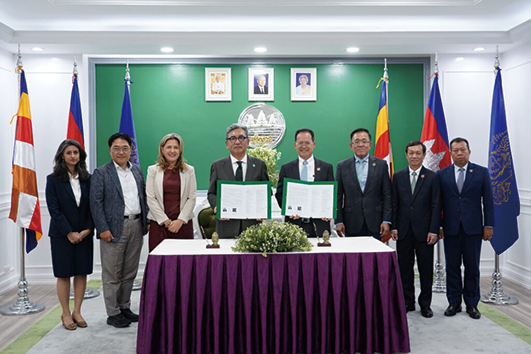
The Global Green Growth Institute (GGGI) announced that Director-General Kim Sang-hyup made an official visit to Cambodia and Laos from July 27 to 30 to discuss cooperation in climate finance, carbon markets, and water security.
In Cambodia, Kim held high-level talks with the Minister of Environment and discussed a USD 300 million Tonle Sap Basin project and the implementation of Article 6 of the Paris Agreement. He also formally signed the strategic direction for Cambodia’s country cooperation framework.
Building on this cooperation, GGGI plans to expand green investment through climate-tech entrepreneurship, preparations to implement Article 6 of the Paris Agreement, and the development of the green bond market.
In Siem Reap Province, Kim tested an electric tuk-tuk from the Korean climate-tech company VeryWords, gaining firsthand insight into low-carbon mobility. He also discussed cooperation on climate technology and carbon markets with the Ambassador of the Republic of Korea to Cambodia.
In Laos, he attended a meeting of the Asian Parliamentary Water Council in Vientiane and emphasized the importance of cross-border cooperation on water security in the Mekong River Basin. He also paid a courtesy call on the Prime Minister of Laos and agreed to expand sustainable development cooperation with countries in the Global South.
IGC George Mason University Successfully Concludes Incheon Global Citizenship Camp
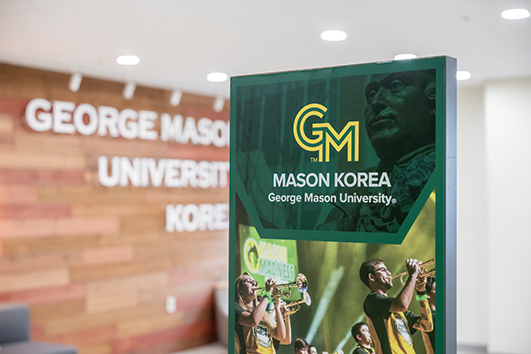
The 2026 Incheon Global Citizenship Camp, hosted by George Mason University Korea at the Incheon Global Campus (IGC), concluded successfully.
The camp was designed as a participatory educational program that combined global citizenship education, peace education, the UN Sustainable Development Goals (SDGs), debate, and sports-based cooperative activities. It incorporated Incheon’s regional characteristics and the border- and peace-related resources of Gyodongdo Island.
A total of 30 students from 24 middle schools in Incheon participated, interacting with peers from diverse backgrounds, including those from the old downtown area, new towns, and island communities. The program gave students opportunities to strengthen their inclusion and collaboration skills as global citizens.
Students from Incheon National University’s debate club served as facilitators, supporting interactive learning about food security and the climate crisis through campus tours, special lectures, and board games.
Participants also visited the Nanjeong Peace Education Institute of the Incheon Metropolitan Office of Education and Gyodongdo Island to learn about the history and meaning of peace in border regions. Through sports-based cooperative activities and team projects, they further developed their communication and problem-solving skills.
George Mason University Korea plans to continue supporting students in developing global competencies and a strong sense of social responsibility.
Korea Polar Research Institute Joins EU Antarctic International Research Project as Asia’s Only Participating Institution
The Korea Polar Research Institute (KOPRI) announced that it will participate in SYNCHRONY (Synchronized Southern Ocean and Antarctic Observing System), an international joint research project led by Germany’s Alfred Wegener Institute (AWI).
Supported by the European Union’s Horizon Europe program, the project will run from August 2026 to July 2030 and include 27 research institutions from Asia, Europe, Oceania, and Africa. KOPRI is the sole Asian participant.
Researchers will use icebreakers and autonomous observation equipment to conduct integrated observations of the atmosphere, sea ice, oceans, and ecosystems across Antarctica and the Southern Ocean. The joint research aims to improve the accuracy of climate change projections.
The project will also standardize observational data across participating institutions and develop new climate and ecosystem data products. In addition, it will provide scientific evidence for climate policymaking by linking its work to international polar research initiatives.
KOPRI’s participation is expected to provide an opportunity to connect Korea’s polar research achievements with the international collaborative research framework.
Incheon Seeks Cooperation with International Organizations to Attract UN Global AI Hub
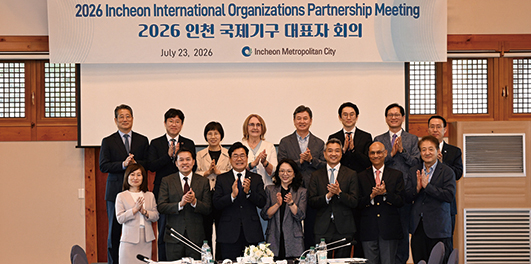
On July 23, the City of Incheon hosted a meeting at Gyeongwonjae in Songdo International City of representatives from 15 international organizations based in Songdo to discuss cooperation to attract the government-backed UN Global AI Hub.
The UN Global AI Hub is a international cooperation platform intended to establish global AI standards and ethical norms and to share related technologies with developing countries.
During the meeting, representatives also shared information about major projects and community cooperation initiatives undertaken by their organizations. They agreed that AI is an important tool for addressing common global challenges, including climate change, disaster management, health, food, and education, and committed to strengthening cooperation with the City of Incheon.
Since attracting the United Nations Asian and Pacific Training Centre for Information and Communication Technology for Development (UNAPCICT) in 2006, Incheon has brought 15 international organizations to Songdo International City.
Building on Songdo’s concentration of international organizations, the city plans to pursue the UN Global AI Hub and to continue related cooperation with international institutions based in Songdo.
Yonsei Science Park Master Plan Begins, Advancing Songdo Innovation Ecosystem
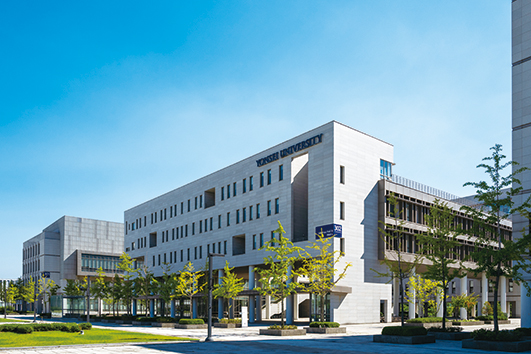
A master plan is being developed for Yonsei Science Park (YSP II), the second phase of Yonsei University International Campus in Songdo.
According to the Incheon Free Economic Zone Authority, project developer Songdo Global University Campus Development Co., Ltd. will invest KRW 710 million in the Yonsei University International Campus YSP II Master Plan and Basic Architectural Planning Service, with the work continuing through next June.
The project will revise construction plans for major research facilities to reflect evolving business conditions and advances in advanced industries. It will also prepare a basic architectural plan and proposed revisions to the implementation plans for Songdo Districts 7 and 11.
Yonsei Science Park is being developed to create an innovation ecosystem that supports research and startups in future industries, including biotechnology, AI, and quantum technology.
The project includes Songdo Severance Hospital, the K-Bio Lab Hub, the Bio Process Training Center, the Pharmaceutical and Bio Commercialization Center, and a Quantum Computing Cluster.
The master plan is expected to provide a framework for creating an innovation cluster that links research, healthcare, and startup functions, uses limited project funding efficiently, and responds to changes in the advanced-industry environment.
Most Viewed
-
Meet a National Museum in IFEZ < Interview No. 15 Located in Songdo International City, the National Museum of World Writing Systems was born from both pride and responsibility: the pride of a country that created Hangeul, one of the most remarkable writing systems in human history, and the responsibility to share the value of writing with the world. Shin Yong-suk, International Cooperation Advisor to the Incheon Free Economic Zone Authority (IFEZA), met with the museum’s newly appointed director, Kim Myung-in, to discuss the museum’s present and future. A literary critic, former professor at Inha University, and former editor of the quarterly journal Hwanghae Review, Director Kim brings a deep background in literature and written culture to his new role.
-