- Date 2026-10-30
- Hit 108
New IFEZ Commissioner Visits Business Sites on His First Day
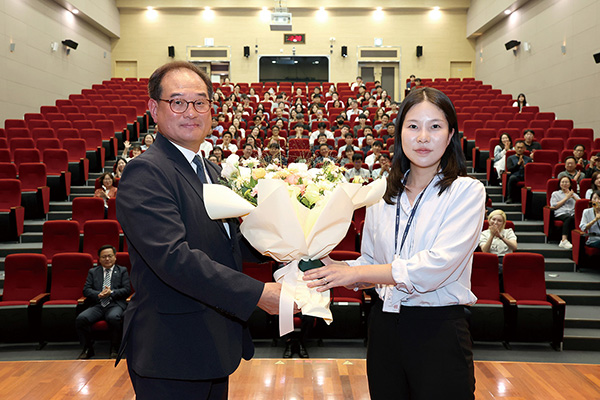
Kim Jong-cheol took office as the ninth Commissioner of the Incheon Free Economic Zone Authority on September 18. His agenda has four priorities: attracting investment, strengthening the industrial ecosystem, expanding culture and wellness, and encouraging shared growth. He also intends to advance the designation of southern Ganghwa as a new Free Economic Zone. Having worked in foreign investment and trade at the Ministry of Trade, Industry and Resources and the Korea Trade-Investment Promotion Agency (KOTRA), Commissioner Kim began his term by visiting major business and development sites. At Amkor Technology Korea in Songdo International City, his first stop, Kim heard about semiconductor investment and the challenges companies face, and discussed ways to improve the business environment. He then visited a reserved development site on Yeongjong to consider its potential for advanced industries and future investment. At Cheongna Haneul Bridge, he examined how attractions such as the observatory could be developed for tourism. Following visits to all three international cities, he plans to incorporate the concerns raised on site into policies for investment, local industries, and quality of life.
Hana Financial Town Completed: A New Home for 4,000 Finance and IT Professionals
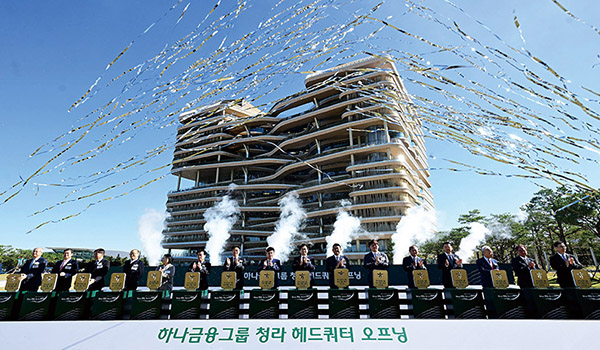
Hana Financial Group celebrated the opening of its Cheongna headquarters on October 2, marking the completion of Hana Financial Town. The project has taken shape in stages since the first agreement in 2012: an integrated data center opened in 2017, followed by Hana Global Campus in 2019. The group headquarters was completed in May 2026, and staff from major affiliates began moving in during September.
Around 2,200 employees from 10 group affiliates—including Hana Financial Group, Hana Bank, Hana Securities, and Hana Card—are relocating to the new headquarters in phases. Together with the integrated data center, Hana Financial Town is expected to house approximately 4,000 finance and IT professionals. Hana estimates that it will generate roughly KRW 3.4 trillion in direct and indirect economic benefits and support 15,000 jobs over the next decade. Plans also include a KRW 200 billion Unicorn Fund for innovative Incheon companies and KRW 150 billion in credit guarantees for technology-based SMEs, laying the groundwork for growth across the region.
Housing Workshop Helps International Residents Understand Korean Rental Contracts
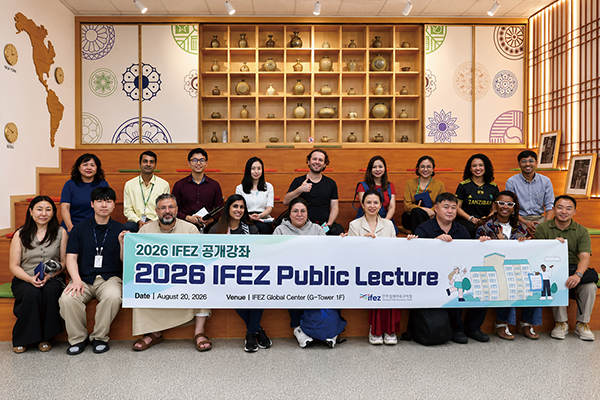
Understanding Korea’s rental system can be daunting for newcomers. To help foreign residents rent more confidently, IFEZ held a practical housing workshop at its Global Center in Songdo’s G-Tower on August 20. The program responded to a February–March survey of 502 foreign residents and workers, who identified housing as the area most in need of improvement.
A licensed real estate agent walked participants through jeonse (a lump-sum deposit lease), monthly rent agreements, required documents, and jeonse deposit guarantee insurance. The workshop also covered common pitfalls and gave residents a chance to raise questions and exchange experiences. IFEZ plans to continue offering practical guidance that helps foreign residents settle more comfortably and securely in the community.
Citizens Join Forces to Shape Smarter City Services
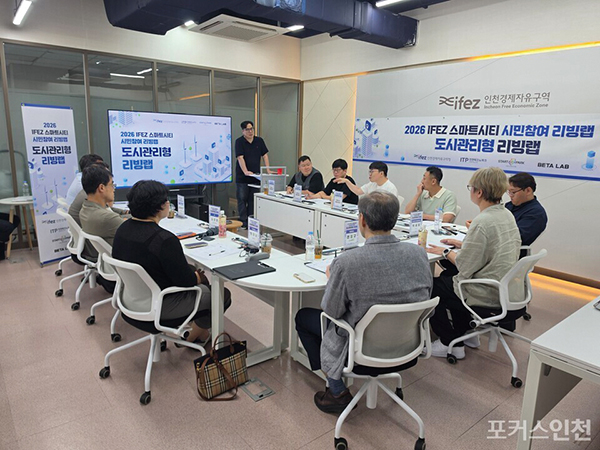
Residents are helping turn everyday frustrations into practical smart-city solutions through the Smart City Citizen Participation Living Lab. The initiative brings citizens together with facility managers, specialists, and businesses to identify problems, develop ideas, and test them in real settings. Ten sessions are scheduled through November, covering both urban management and daily life. The emphasis is on collaboration and hands-on testing—not simply collecting suggestions.
The urban management group looks at challenges in integrated monitoring and infrastructure operations, while citizen researchers in the daily-life group share experiences and propose improvements. Selected ideas will undergo proof-of-concept (PoC) testing before potentially being developed into wider applications for sustainable city management. A results-sharing event in December will bring participants and partner organizations together to review promising solutions and explore the next steps.
K-Bio Lab Hub Breaks Ground in Songdo to Support Biotech Startups
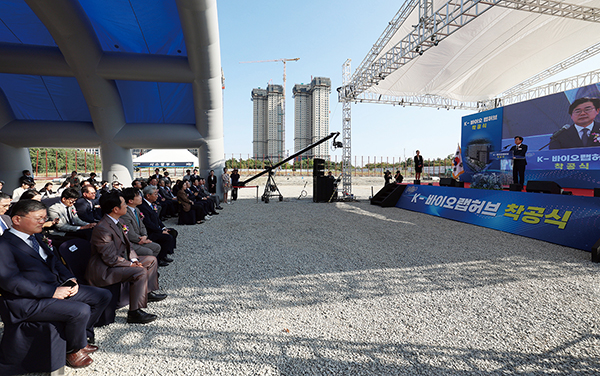
The Ministry of SMEs and Startups held a groundbreaking ceremony for the K-Bio Lab Hub at Yonsei University’s International Campus in Songdo on September 30. Following project approval and the selection of Songdo in 2021, the hub moved into construction after feasibility studies and architectural design. Yonsei University is providing the land, the Incheon Metropolitan Government is funding construction, and the ministry is supporting operations, laboratory equipment, and R&D programs. Scheduled for completion in November 2028, the facility is planned to accommodate 50 early-stage startups and 10 growth-stage companies.
Research equipment will be installed in phases even before the main building opens. By October 2026, the plan calls for 24 instruments across 17 categories in temporary facilities at Yonsei University’s International Campus. At full scale, the hub will offer 134 instruments across 59 categories. Resident companies are to be selected in 2028, with KRW 41.4 billion earmarked from 2029 for 60 companies through six specialized programs. Support will cover the journey from drug discovery and preclinical and clinical development to regulatory approvals and fundraising, helping promising research move closer to the market.
Cheongna Lake Park’s Lake House Reopens with More Ways to Enjoy the Water
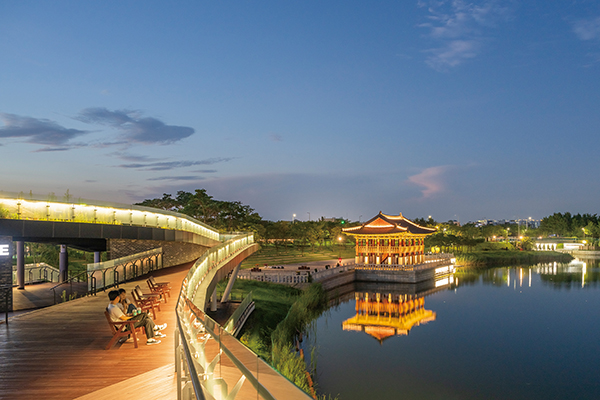
Cheongna Lake Park’s Lake House welcomed visitors again on September 23 under a newly selected operator. Built in 2019, the facility includes a shop and water recreation services on the first floor and a cafeteria upstairs. After an open bidding process in August, IFEZ brought the services together under a single operator, covering everything from safety and facility management to customer service.
Visitors now have more choices on the water. Alongside traditional pedal boats, the Lake House offers Cinderella Boats, Moon Boats, and Family Boats, with prices ranging from KRW 35,000 to KRW 39,000. During the day, the lake provides a peaceful backdrop for a leisurely outing; after dark, illuminated boats create a different view. The refreshed Lake House adds another place to relax and play at Cheongna Lake Park.
Songdo Bioprocessing Training Center: 2,528 People Trained by K-NIBRT
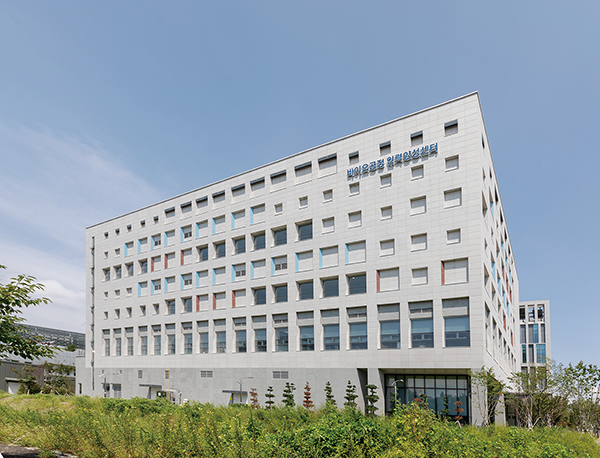
The Bioprocessing Training Center, which opened in Songdo in 2025, began full-scale courses in March 2026. Developed over five years from 2021, the four-story, approximately 6,600-square-meter center provides GMP-aligned classroom and hands-on training. Yonsei University’s K-NIBRT project team offers programs tailored to industry needs for employees and job seekers. By August, 2,528 people had received training, including 555 who used the center’s practical training facilities.
The center adds workforce development to Songdo’s globally competitive biopharmaceutical manufacturing base. It joins other local facilities, including the Cytiva Fast Trak Center and the Thermo Fisher Bioprocess Design Center. Celltrion and Samsung Biologics are also involved in training through their own programs and university partnerships. IFEZ plans to strengthen these connections to ensure that Songdo’s growing industry can find the skills it needs.
Korean Air to Invest KRW 150 Billion in Yeongjong Aviation MRO Cluster
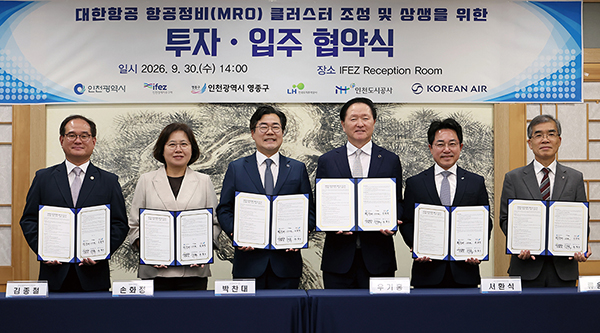
A major aviation maintenance, repair, and overhaul (MRO) cluster focused on aircraft engines and key components is planned for Yeongjong International City. On September 30, six partners—the Incheon Metropolitan Government, Incheon Free Economic Zone Authority, Yeongjong-gu, Korea Land and Housing Corporation (LH), Incheon Urban Corporation (iH), and Korean Air—signed an investment and site-occupancy agreement at Songdo’s G-Tower. The partners will work together on site development, administrative support, training local specialists, and recruiting workers for the cluster at the Yeongjong Aviation General Industrial Complex.
Korean Air plans to invest approximately KRW 150 billion in a 101,151-square-meter engine and component maintenance facility on a 50,692-square-meter site. Construction is scheduled from January 2029 to December 2031. The project will draw on nearby Incheon International Airport and existing maintenance facilities, including engine test cells. Once operational, the cluster is expected to raise Korean Air’s annual engine maintenance capacity from 88 to 502 units and support more than 2,000 specialist jobs, reinforcing Yeongjong’s role in the aviation industry.
Most Viewed