- Date 2026-08-28
- Hit 13
ISSUE 1
A City Connected by Migratory Birds, a Platform Recognized Worldwide
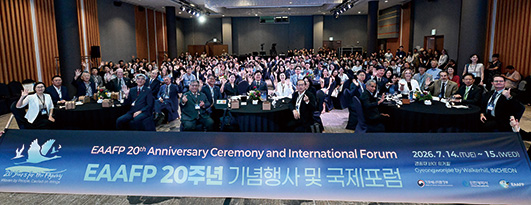
Migratory birds cross national borders, yet their survival depends on a connected ecological network. Only when breeding grounds, stopover sites, and wintering habitats remain healthy and interconnected can a complete ecosystem be sustained. This is why Incheon is recognized as a key city along the East Asian–Australasian Flyway (EAAF).
The tidal flats along Incheon’s West Sea coast—including Songdo, Yeongjong, and Ganghwa—serve as vital habitats along one of the world’s major migratory bird flyways. They provide essential breeding and resting grounds for endangered waterbirds, including the Black-faced Spoonbill, and are important for maintaining global biodiversity.
Since hosting the Secretariat of the East Asian–Australasian Flyway Partnership (EAAFP) in Songdo in 2009, Incheon has continued to strengthen international cooperation through conferences, joint research, educational programs, and public participation initiatives, evolving into a leading center for migratory bird conservation. In 2025, the city was elected to the Standing Committee, the EAAFP’s highest decision-making body, further solidifying its role as a key partner in international environmental governance.
The results of these conservation efforts are reflected in the numbers. Through sustained conservation efforts and international cooperation, the global population of the Black-faced Spoonbill has grown from just 430 birds in 1995 to more than 7,000 by 2025. Today, more than half of the world’s Black-faced Spoonbills inhabit the Incheon area, and the Namdong Reservoir has become one of the species’ largest breeding sites. This is more than a population increase. It is evidence that the region’s tidal flats and wetlands remain healthy ecosystems—and a powerful example of how cities and nature can thrive together.
ISSUE 2
From Biodiversity to a Sustainable City
: IFEZ’s New Vision

IFEZ is evolving from an industrial and innovation hub into a global ecological city where people and nature coexist. At the center of this vision is the Songdo International Eco Center Project.
In collaboration with the Wildfowl & Wetlands Trust (WWT) of the United Kingdom, the Incheon Free Economic Zone Authority is developing an international center for ecological education and research in Songdo International City. Modeled after the London Wetland Centre, the Songdo International Eco Center is envisioned not only as an ecological facility but also as a comprehensive platform integrating wetland conservation, environmental education, international cooperation, and public participation.
The center will protect habitats for diverse species while connecting nature to the urban environment. It will also reflect the region’s history and culture, creating a place where visitors from around the world can better understand the value of biodiversity.
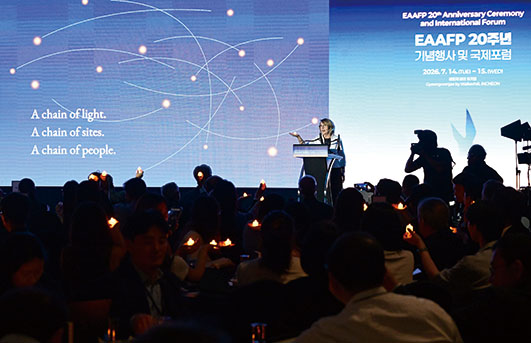
These efforts have taken on even greater significance as the East Asian–Australasian Flyway Partnership (EAAFP) marks its 20th anniversary. At the commemorative event, Incheon became the first city in the world to receive the IUCN Biodiversity Excellence Recognition, earning international recognition for its achievements in ecological conservation and global cooperation.

The recognition reflects more than the protection of migratory birds and tidal flats. It acknowledges IFEZ’s ongoing efforts to transform biodiversity into a source of urban competitiveness. Looking ahead, IFEZ will continue to build a sustainable global city where nature and industry, urban development and the environment, advance together through collaboration among international organizations, research institutions, and local communities.
IFEZ Biodiversity Facts
2009 – Hosted the Secretariat of the East Asian–Australasian Flyway Partnership (EAAFP) in Songdo
Hosted the 20th Anniversary Commemorative Event for International Cooperation under the EAAFP
First city in the world to receive the IUCN Biodiversity Excellence Recognition
An international partnership for migratory bird conservation involving 18 governments and 42 partner organizations
Approximately 54% of the world’s Black-faced Spoonbills inhabit Incheon
Namdong Reservoir is one of the world’s largest breeding sites for the Black-faced Spoonbill
Signed an MOU with the Wildfowl & Wetlands Trust (WWT) to jointly develop the Songdo International Eco Center
The Songdo International Eco Center will serve as a global ecological platform integrating ecological conservation, environmental education, and international cooperation
Most Viewed