- Date 2026-08-28
- Hit 59
From a smart city that connects data
to an AI city that learns, predicts, and operates
Awakening the intelligence of the city
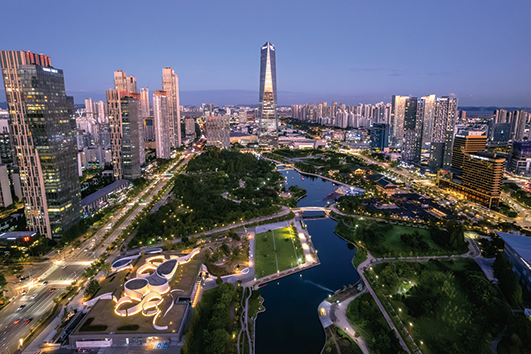
For more than 20 years, IFEZ has developed its smart city infrastructure by connecting urban data to make the city safer and more convenient. Building on this experience and accumulated data, IFEZ is now adding AI to shape a new future—an “AI City” that can understand changing conditions, anticipate what comes next, and identify better ways to respond. This transformation goes beyond adopting new technologies. It will reshape how the city operates, how citizens experience daily life, how industries grow, and how IFEZ collaborates with cities around the world. First, we explore IFEZ’s vision for an AI City and the future that AI will help create. We then trace IFEZ’s journey over the past two decades as it has evolved step by step from a smart city toward an AI City.
Vision for AI City
How AI Will Shape the Future of IFEZ

AI—operation.
The City Predicts First
AI-driven urban management in IFEZ begins with prediction. By analyzing the flow of the city, AI identifies risks in advance, supports real-time monitoring and response, and then learns from the results.
This creates a full-cycle operating model: Predict, Monitor, Respond, and Learn.
The first large-scale testbed was the Incheon Pentaport Rock Festival, which draws more than 100,000 visitors. Before the event, AI predicted possible congestion areas; during the festival, it monitored crowd density, fire risks, and emergency situations in real time; afterward, it analyzed the data and generated reports for future operations.
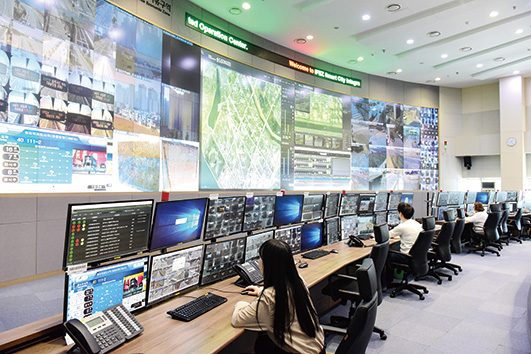
Looking ahead, the Smart City Operations Center will evolve into the IFEZ AI City Operations Center—a next-generation operational hub that analyzes citywide data and supports intelligent decision-making. Proven through field demonstrations, the system will gradually expand into transportation, disaster management, environmental monitoring, and energy management to improve the efficiency of urban operations.
AI—smart living.
Smarter Everyday Life
The changes brought by an AI city are felt first not in grand technologies, but in daily life. By analyzing data related to mobility, safety, energy, and health, AI helps deliver faster, more precise public services while allowing the city to detect and respond to risks earlier.
By reducing traffic congestion, anticipating disasters and safety incidents, and optimizing the use of urban resources, AI creates a safer and more efficient living environment.
Services that support city operations will also continue to expand, including AI chatbots that allow operators to ask questions in natural language and instantly access response procedures and operational guidance.
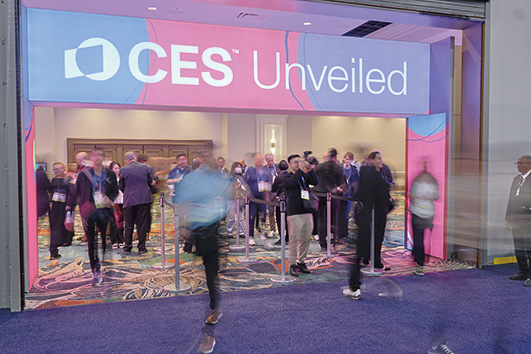
The Incheon AI City Vision unveiled at CES 2026 captured this future clearly: a city where AI works quietly in the background to make everyday life smarter, safer, and more convenient.
AI—innovation hub.
The City Becomes a Testbed for Industry
IFEZ’s AI City vision does not stop at urban management; it also reaches into industrial innovation.
IFEZ is integrating AI across manufacturing, logistics, food production, and biotechnology, while transforming the entire district into an open testbed for companies to validate new technologies and services in real-world urban environments.
In particular, the convergence of AI and biotechnology is emerging as a new growth engine for the Songdo Bio Cluster. IFEZ is expanding AI-based bio-data analysis, precision medicine, and global collaborative research, while strengthening an open innovation ecosystem in which businesses, universities, and research institutes share technologies and data.
By combining its established biotechnology foundation with AI, IFEZ is creating new opportunities for industrial innovation and for global collaboration.
AI—global standard.
A City That Sets a Global Standard
IFEZ’s vision for an AI city extends beyond a single region. Its goal is to standardize an AI-driven urban operating model for adoption by cities around the world.
To achieve this, IFEZ is building partnerships with leading cities worldwide to share AI city strategies, technologies, and operational experience. Through collaboration with international organizations, it is also working to establish standards for sustainable urban development and ethical AI governance.
The task is not only to advance technology, but also to ask how AI can be used safely, responsibly, and for the public good.
By integrating AI with two decades of smart city experience, IFEZ is working to create a global model for the next generation of cities.
Road to AI City
IFEZ’s Journey from Smart City to AI City
2012
Incheon Smart City Corporation established (a public-private partnership (PPP) for smart city development)
2014
Phase 1 of Cheongna International City completed
Songdo Smart City Operations Center completed
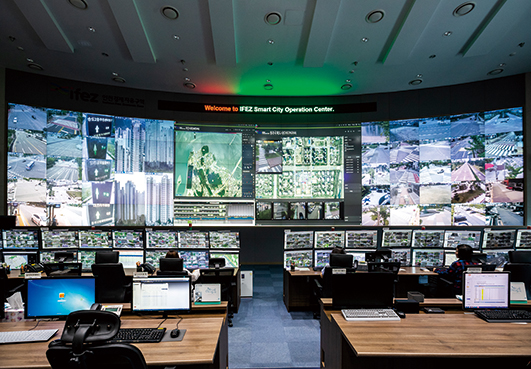
Smart City Operations Center welcomes more than 8,600 visitors during its first three years
Since its opening, the facility has attracted prominent visitors from Korea and abroad, welcoming a record 8,600 visitors. It continues to serve as a venue for benchmarking and mutual cooperation.
2017
Phases 1–4 of Songdo International City completed
Smart city platform drone service exported to India (KRW 250 million)
2019
Traffic signal control system exported to the Philippines (KRW 100 million)
Phases 5 and 7 of Songdo International City completed
Investment Block 2 in Cheongna International City completed
Queen of Belgium visited the Smart City Operations Center
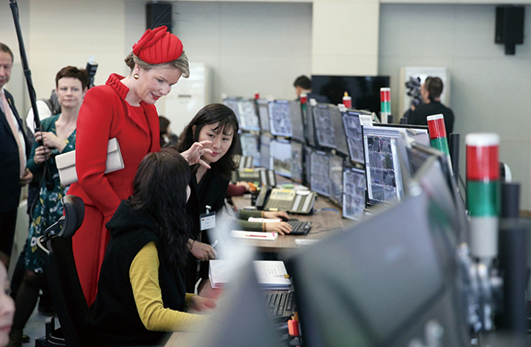
GLOBAL IFEZ
Countries Visiting the Smart City Integrated Operations Center
May 2015 – Minister of Multimedia, Malaysia
2016 – President of Egypt
2016 – President of Myanmar
2019 – Queen of Belgium
2019 – Vice President of Colombia
2021 – President of Costa Rica
November 2022 – President of Kenya
2025 – Mayor of Seremban, Malaysia
* In addition, visitors have come from approximately 90 countries, including the United States, France, Germany, Russia, China, India, Japan, and Vietnam.
2021
Phase 6-1 and Phase 8 of Songdo International City completed
Eco-Friendly Mixed-Use Complex in Cheongna International City completed
The 5th World Smart City Expo (WSCE 2021)
2021 IFEZ Smart City International Symposium
Incheon Startup Park opens
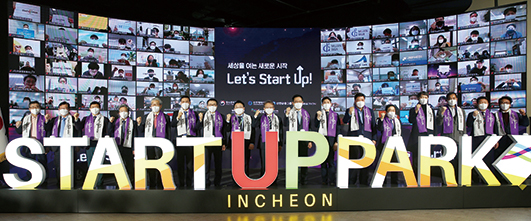
Opening ceremony of Incheon Startup Park — “Let’s Start Up”
Incheon Startup Park opened in 2021 with the goal of becoming a “Korean Silicon Valley.” It supports innovative startups based on Fourth Industrial Revolution technologies as well as those combining advanced technologies with biotechnology.
2022
Phase 2 of the Cheongna International City IHP completed
2022 IFEZ Smart City International Symposium
2023
Phase 1 and Phase 2-1 of Yeongjong Sky City completed
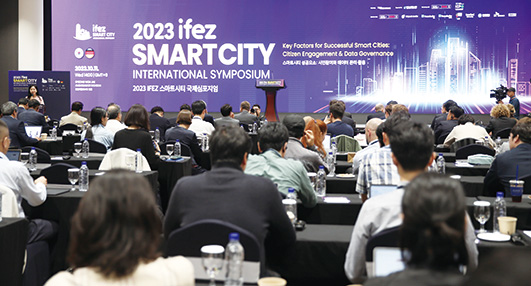
2023 IFEZ Smart City International Symposium
2024
Incheon Startup Week (ISW SURF 2024) held
2025
Phase 2-2 of Yeongjong Sky City completed
Global Top 10 City Week 2025
Demonstration of the IFEZ Zero-Energy Smart City Integrated Platform Project
Phase 1 of the Smart City Basic Services Project completed
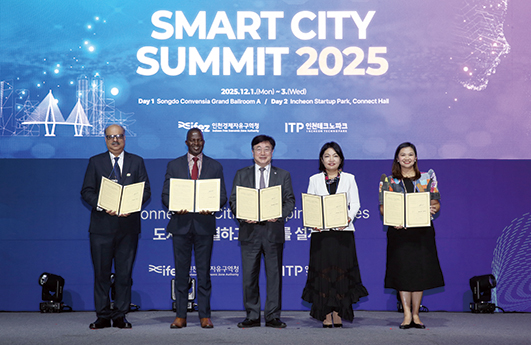
Declaration of the AI City Initiative
On December 1, 2025, IFEZ announced the world’s first “AI City Initiative” at Global Top 10 City Week 2025. IFEZ plans to establish an intelligent, autonomous urban operating system in which AI functions as the city’s central intelligence and expand the model globally.
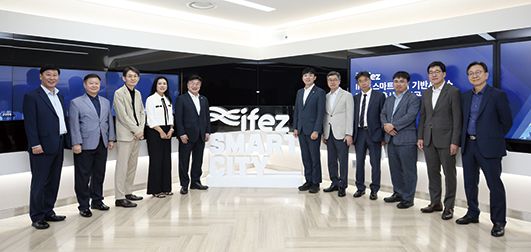
Completion ceremony for Phase 1 of the IFEZ Smart City Basic Services Project
On August 1, 2025, IFEZ held a completion ceremony for the first phase of the Smart City-Based Services project. By establishing smart city infrastructure through the project, IFEZ laid the foundation for advancing toward a smart city where citizens can experience the benefits in their daily lives.
2026
Utility pipeline construction completed in Songdo District 6-8
Incheon AI City Vision unveiled at CES 2026
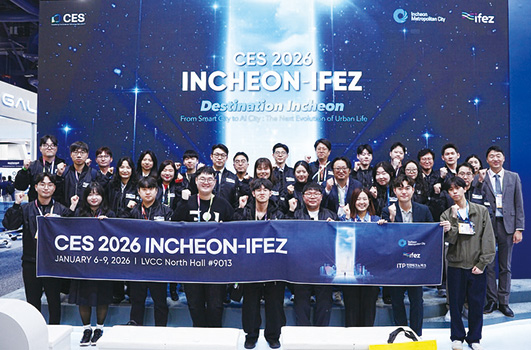
CES 2026: Incheon AI City Vision
At CES 2026, the Incheon Free Economic Zone Authority unveiled the “Incheon AI City Vision” under the theme “Destination Incheon—From Smart City to AI City.” Presenting a future strategy for applying AI across the city, Incheon introduced its new direction to the world as it moves beyond a smart city toward becoming a global leader in AI-driven urban innovation.
2028
Infrastructure completed in Songdo
District 6-8 (planned)
Smart City Basic Services Expansion Project completed (planned)
2030
Infrastructure completed in Songdo
District 11 (planned)
Most Viewed